Article
How to Get More Clients Without Paid Ads: Peter Boolkah's Strategy
Topic · Growth and scaling · 6 min read · Published 27.06.2025 · Updated 22.10.2026
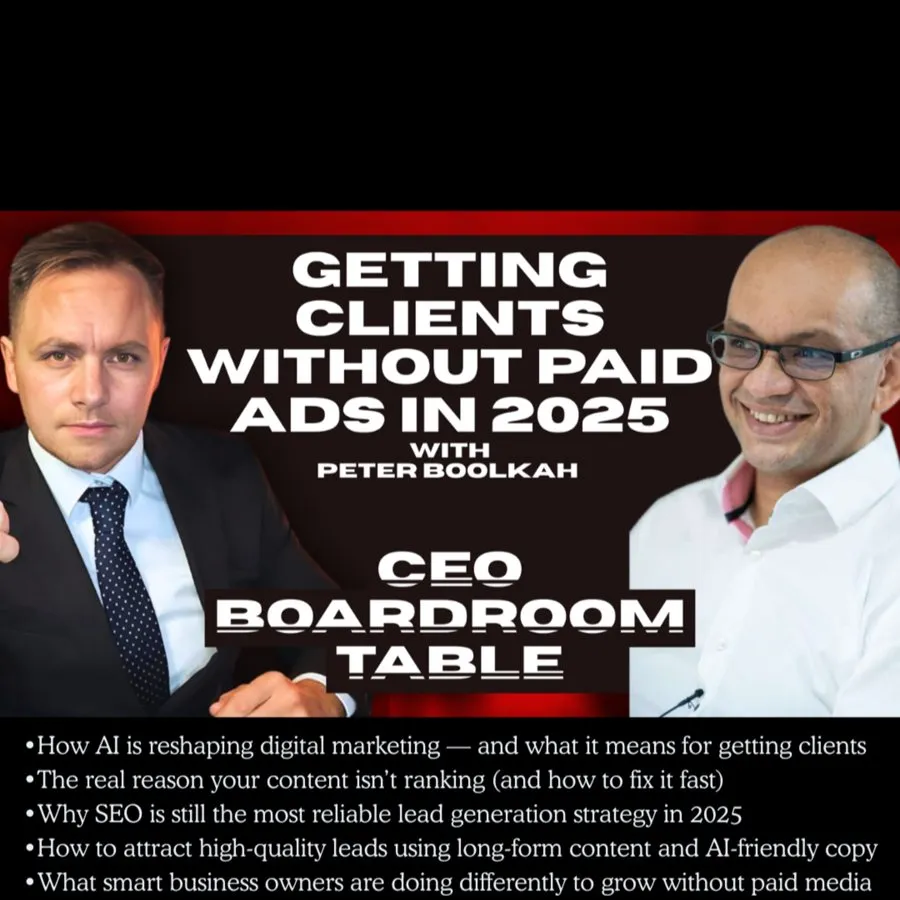
To get more clients without paid ads, start by working out where your customers actually spend their time, master one channel there instead of trying to be everywhere, hire someone genuinely good to run it, and put your money into content that keeps working after you stop paying for it. That’s the strategy business and executive coach Peter Boolkah laid out when he joined me on the Mentor Business Podcast, and it’s how he wins his own clients today.
Peter isn’t talking theory. After losing most of his business overnight when international travel stopped in 2020, he went through five marketing agencies, spent £60,000 and, in his words, “got nothing for it”. So he worked out how to fix it himself, built his own search agency off the back of it, and now gets his coaching clients from appearing on the first page of Google. Without paid ads.
Listen to the full conversation on Spotify or Apple Podcasts.
How do you get more customers without paid ads?
Start with where your customers are, not where you’d like them to be. Peter’s first point was blunt: “A lot of people do marketing on channels their customers don’t exist on.” Before you post anything, get clear on your ideal customer profile and where those people actually hang out.
He added something most owners miss: sometimes the person you need to reach isn’t the decision maker at all. A lot of business comes through what he calls significant others: a partner who sees something and says “you must see this”, or the managers and staff an owner listens to. When I market into a business, I always ask who the owner is actually listening to. It’s rarely the cold message in their inbox.
He also made a point about LinkedIn that surprised me, given how good he is at it. He’s having fewer real conversations there now, because so many of the people he messages aren’t the person themselves; it’s an assistant or an agency running the account. They’re “there in body, but not in soul”. So check whether the channel still works for you, rather than assuming it does because it used to.
How do you rank on ChatGPT and get on the first page of Google?
Busy people want the answer here and now, and more of them are asking ChatGPT, Perplexity or Google’s AI instead of clicking through websites. Peter’s view is that these tools lean on what already ranks well on Google, so being in the top three organic results matters more than ever. As he put it, there’s an old joke in his industry that the best place to hide a body is the second page of Google, because nobody goes there.
The second part matters just as much: once you rank, your content has to actually answer the question the person is asking. AI tools reason through a question and give a fuller answer than a basic search. If what you’ve published is a couple of thin paragraphs, there’s nothing for them to work with. “If data is gold,” Peter said, “then words are platinum.” It’s the words you publish that let these tools find you, trust you and recommend you.
That’s exactly what happened with one of my clients this year. She asked an AI assistant for help, it read my website in full, and it named me. The website did the selling before we’d even spoken.
How do you get clients at each stage of the business?
Peter broke it down by stage, because a start-up and a business heading for eight figures have very different budgets.
When you’re starting out, pick one channel and master it. You’ve got no cash, so you’re doing it yourself. Don’t fall into what Peter calls guilt marketing, where you feel you have to be on every platform and end up “everywhere but nowhere”. Learn one platform properly and add value to it. If you add value, the platform gives you visibility for free. Understand what the algorithm wants: you’re marketing to the platform first so it lets the end user see you.
When you’ve got a small team, don’t hand marketing to a trainee. The first thing a lot of owners do is hire an apprentice to do the marketing: someone who doesn’t know what they’re doing, working on platforms they don’t understand. If you’re time-poor, you don’t have the time or the expertise to train them up. Get somebody good, who can set the strategy and drive it, so you can work on the business.
This was one of the biggest lessons Peter has given me. I used to believe in learning the skill, building the system, then passing it on. He asked a simpler question: why not get someone better than you at it? I see owners trying to fill roles like this on a junior salary, when the right person on a proper salary could blow the constraint in the business wide open. It’s the difference between a match and a stick of dynamite.
As the business grows, make sure the right leader runs the department. Very often the best technician gets promoted to head of department and told to take the strategy forward, without the skills to do it. That’s how you end up with a mediocre marketing department.
How do you hire the right person to run your marketing?
It isn’t usually the money. Peter’s view is that owners aren’t scared to spend it; they don’t know how to “weed out the bullshitter”. Some candidates talk the best game in the interview and can’t deliver. The owner gets burnt, and then doesn’t have the confidence to hire again.
That belief, “I tried it before and got burnt”, is one of the most common things holding owners back from the next stage. What got you to your first million won’t get you to five or ten. The fix isn’t to stop hiring; it’s to fix how you hire and how you hold people to account, and to “fail forward faster”, as Peter put it.
Are Google Ads worth it?
No. Peter was clear that paid advertising has its place. His point is that you’re going to pay for clients one way or another, so pay for it in your content. The moment you switch ads off, you lose the benefit. Great content that performs is “the gift that keeps on giving”.
He compared relying on ads to a drug: you get the rush while you’re on it, but what do you do when you have to come off? And if your keyword is a long way from the top of Google, sponsoring it costs more and doesn’t even guarantee you page one. Meanwhile the price of every platform goes up as more people bid, so your cost to win a client keeps climbing and eats your margin. Every platform is a business, not a charity; “no one’s here to do you a favour ever.”
His last word was the one I’d pin to the wall: marketing is there to generate leads and drive revenue. If someone tells you they’re marketing for “brand presence”, ask them what that’s actually for.
How do you generate leads, starting this week?
- Write down where your best customers actually spend their time, and who they listen to. Check your channels against it.
- Pick one channel and stop the guilt marketing on the others until that one works.
- Look at who runs your marketing. If it’s the most junior person in the business, that’s probably your constraint.
- Publish content that fully answers the questions your customers ask, so Google and the AI tools have something to recommend.
- Keep ads as an accelerator, not a life support machine.
Want help with the constraint in your business?
I’m Dr Lewis Haydon, a business coach and mentor in Birmingham, UK, and I own and invest in businesses. If more clients is the problem, the constraint is usually one of the things above: the wrong channel, the wrong person running it, or nothing published worth recommending. Book a virtual coffee and I’ll tell you straight which it is. My prices are published.
More from Peter on the show: Sales vs Marketing: Andy Bounds and Peter Boolkah.