Article
Sales Closing Techniques: Why the Best Salespeople Don't 'Close'
Topic · Growth and scaling · 4 min read · Published 21.01.2025 · Updated 23.10.2026
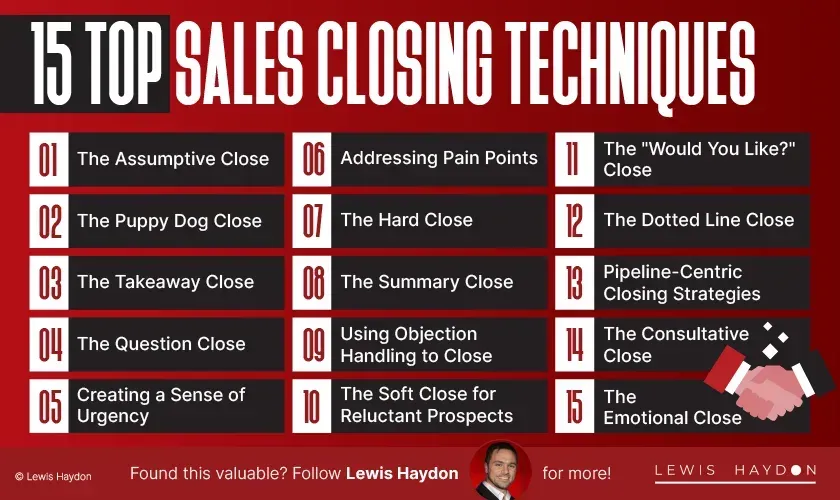
The best sales closing technique is not to think of it as closing. You’re helping someone make a buying decision. Do the work earlier in the conversation, ask for a clear decision, bring any concerns into the open, agree the next step, and protect the relationship so they buy again. “Always be closing” wins you one sale and loses you the next ten.
You do need people to commit. That part isn’t up for debate. It’s the word “closer”, and the mindset that comes with it, that costs you money.
Why “always be closing” damages your sales
When you’re thinking “close, close, close”, the conversation becomes about you and your number, not about them and their problem. Customers pick that up. They can feel when they’re being worked, and people don’t commit to anything while something feels off.
And when they do say yes under pressure, you get buyer’s remorse. They don’t come back, they don’t refer you, and they tell people how they were sold to.
It hurts your team too. A salesperson who’s been told they must be a closer feels like a failure every time a prospect says no, even when no was the right answer.
The four kinds of salespeople
Think of it as a ladder:
- The administrator. Sends the quote, then crosses their fingers. Takes no ownership of the decision.
- The tradesperson. Good at the work, untrained in selling. Quotes, races to the bottom on price, rarely follows up, and leans on marketing to make up for a low conversion rate.
- The pushy closer. Hits the number this month. Burns the relationship next month.
- The sales professional. Helps the customer make a good decision and plans for the lifetime of the relationship, not just this order.
Most owner-led businesses have a lot of the first two. The aim is the fourth.
Sales closing techniques that work, without the pressure
1. Earn the close earlier
If you’ve asked good questions, found the real problem and shown how they’re better off afterwards, the close is a formality. Most “closing problems” are really questioning problems from twenty minutes earlier.
2. Ask for the decision, plainly
Plenty of salespeople never actually ask. “Would you like to go ahead?” is a perfectly good closing line. So is “What would you need to see to say yes?”
3. Bring concerns into the open
One of Andy Bounds’s favourite closing questions, from his time on the Mentor Business Podcast, is simply: “Do you have any concerns about this?” It gives the customer permission to say what’s really stopping them, so you can deal with it now instead of losing the deal to an objection you never heard.
4. Summarise what they told you
Play back their problem, what it’s costing them, and what they said good looks like. Then show how your proposal gets them there. A summary close works because it’s their words, not yours.
5. Commit to a next step, every time
Not every conversation ends in an order. Every conversation should end in a commitment: a meeting, a trial, a decision date, a call with the other director. Always be committing, not always be closing.
6. Make no a safe answer
Tell people it’s fine to say no. It lowers the pressure, and the ones who say yes mean it. A clear no is worth far more than a maybe that eats your time for months.
7. Don’t close on price
If the only way to get the yes is to drop your price, you haven’t closed a deal. You’ve bought one. Somewhere down the line the business has to make that money back.
8. Play the long game
Look at how Porsche sells. They put you in an entry-level car and build the relationship until, years later, you’re invited to buy the one most people can’t. They’re not closing you once. They’re looking after a lifetime customer. Small businesses can do exactly the same with their best customers.
How to get your team closing without pressure
- Change the language. Stop talking about “closers” in the office. Talk about decisions, commitments and next steps.
- Measure next steps, not just orders. Track how many conversations ended with a clear next step. It shows you who’s selling well before the orders arrive.
- Review lost deals together. Was it the wrong customer, the wrong price, or a concern nobody asked about?
- Reward repeat business. If you only pay on new orders, don’t be surprised when nobody looks after the customers you already have.
What to read next
- How to improve sales skills, yours and your team’s.
- How to write a sales pitch that sounds like a conversation.
- Sales funnel stages, to see where closing sits in the process.
- Sales KPIs to track every week.
If you’re the only person in the business who can get a customer to say yes, that’s the kind of thing I work on with owners. You can see how I work and what it costs.