Article
What Is a Buyer Persona, and How Do You Create One From Your Best Customers?
Topic · Growth and scaling · 5 min read · Published 18.02.2025 · Updated 23.10.2026
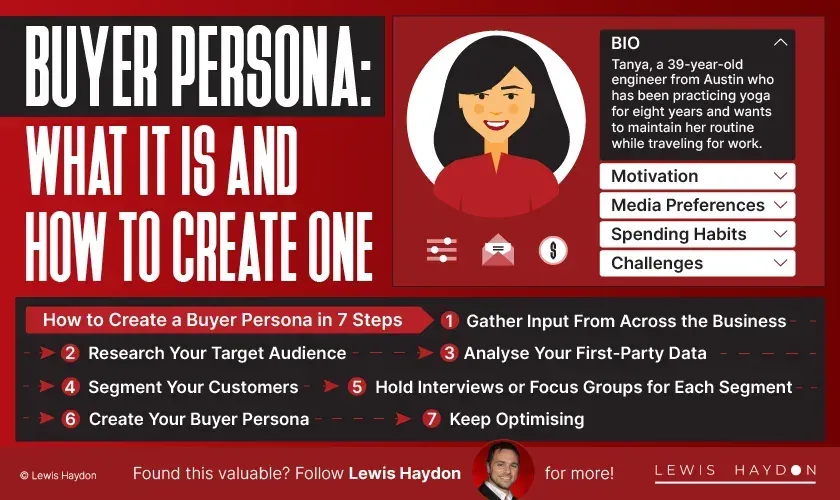
What is a buyer persona? It’s a short, specific profile of the customer you most want more of: who they are, who makes the buying decision, the problem they’re trying to solve, the words they use for it, and why they’d choose you. In B2B it’s often called an ideal customer profile, or ICP. The best ones aren’t invented in a workshop. They’re built from the customers you already have, starting with the ones who are most profitable and best to work with.
Get it right and your marketing, your sales calls and your pitch all get easier, because you’re talking to someone specific instead of everyone.
Why a buyer persona matters
When a cold call feels awful, it’s usually not because you’re being pushy. It’s because you’re pushing the wrong door. Without a clear picture of your ideal customer, you call people who were never going to need you, write marketing that speaks to nobody in particular, and say yes to work that costs you more than it pays.
And even when the wrong customer says yes, you haven’t done right by them. If your service isn’t right for them, you’ve wasted their time and yours.
Buyer persona vs target market
Your target market is the broad group you sell to: manufacturers in the Midlands, say, or professional services firms with 20 to 100 staff.
A buyer persona goes deeper. It’s the managing director inside that market who has grown turnover but can’t see where the margin has gone, who checks your website at 10pm, who’s been burned by an agency before, and who wants a straight answer more than a glossy proposal.
The target market tells you where to look. The persona tells you what to say when you get there.
What goes into a buyer persona
The surface details are the easy part. Sales and LinkedIn outreach specialist James Willis, who joined me on the Mentor Business Podcast, calls them the givens: industry, geography, job title, size of organisation. You need them, but they won’t make anyone read your message.
What makes a persona useful is the layer underneath:
- The problem. What’s going wrong, in their words, not yours.
- The trigger. What’s happened that makes them look for help now.
- The language. The phrases they actually use when they describe it.
- The deeper reason. What solving it means to them: more profit, more time, less stress, a business they could sell.
- The decision. Who signs it off, who influences it, and what they worry about.
- The objections. Price, time, a bad experience before.
How to create a buyer persona in five steps
1. Start with your last ten customers
Here’s the exercise James gives his clients, and it’s the best place to start. List your last ten customers, or every customer if you have a manageable number, and score each one out of ten on:
- Profitability: how much margin they made you.
- Length: how long they’ve stayed.
- The problem you solved: how big a difference you made.
- Where they are now: what’s changed for them as a result.
- Enjoyment: whether you and your team liked working with them.
Add whether they came by referral and whether they pay on time if those matter in your business.
2. Look at the top 20%
The customers at the top of that list are your persona. What do they have in common? Sector, size, who you dealt with, how they found you, what they were struggling with when they arrived. Those common threads are what you write down.
3. Talk to them
Call three or four of them and ask: what was going on when you first got in touch? What nearly stopped you? What would you tell someone in your position? Write down their exact words. That’s the language your website and your sales conversations should use.
4. Write a negative persona too
Just as useful is a picture of who you don’t want. Look at the bottom of your list. Which customers squeezed your margin, chased you on price, paid late or drained your team? Grade your customers A to D. Work out how to move the Bs and Cs up, and accept that some Ds won’t move. Let your competitors have them.
A big name on your customer list can look impressive and still cost you money. I’ve seen it with a client who sold race car parts: their best-known customer squeezed them so hard on terms that, once we looked at the margin, the account was losing money.
5. Test it against the data, and keep updating it
A persona is a starting point, not a final answer. Market to it, then look at what actually happens: which messages get replies, which enquiries convert, which customers stay. Let the data sharpen it. Revisit it every year, or whenever your best customers start to look different.
A note on niching
You’ll hear a lot of advice to “niche down” before you’ve got any data. Be careful. If you narrow your market too early, you can end up cutting off the very data that would tell you who your best customers really are. Start with what your current customers tell you, test broadly enough to learn, and let the results tell you where to focus.
Buyer persona example
Name: Growing Gareth, managing director Business: a family-owned manufacturer, about £4m turnover, 40 staff Problem: turnover has grown for three years but profit hasn’t; everything still comes through him Trigger: a bad quarter, or a key manager leaving His words: “We’re busy, but I don’t know where the money’s going.” What he wants: a business that pays him properly and runs without him on every decision Worries: paying for advice that doesn’t change anything How he finds help: a recommendation from another owner, then checks the website
This is an illustration, not a real client.
What to read next
- Cold calling tips, for reaching the people your persona describes.
- How to write a sales pitch that speaks to them.
- Sales funnel stages, to see where your persona drops out.
- How to increase sales in an owner-led business.
If you’re not sure who your best customers really are, that’s one of the first things I look at with owners. You can see how I work and what it costs.