Article
Pacesetting Leadership: Why Leading From the Front Stops Working as You Grow
Topic · Team, structure and delegation · 4 min read · Published 15.04.2025 · Updated 23.10.2026
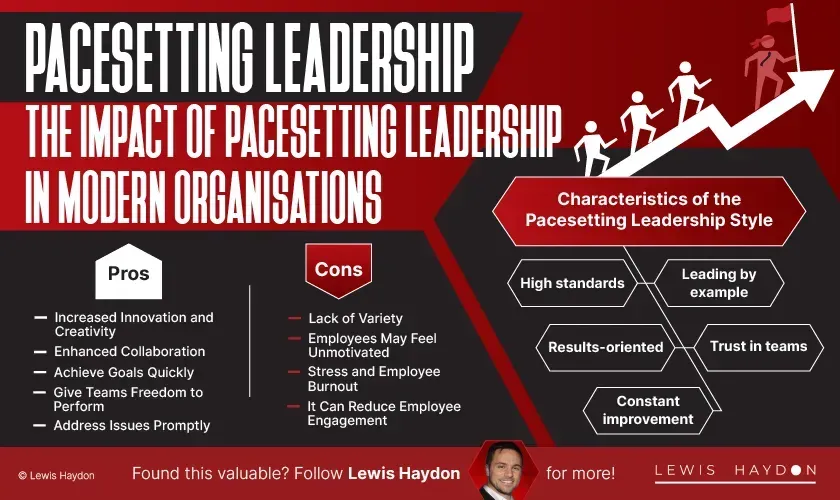
Pacesetting leadership is when the leader sets a very high standard by doing the work themselves, and expects everyone else to keep up. It’s one of the six leadership styles Daniel Goleman described in his 2000 Harvard Business Review article, “Leadership That Gets Results”. It gets fast results from a small, capable, motivated team. Used for long, it burns people out, stops them thinking for themselves, and leaves the owner doing the work of three people. Goleman’s advice was to use it sparingly, and for an owner trying to build a business that runs without them, that’s right.
Most owners are pacesetters by default. It’s how the business got started. It’s also why it stalls.
What is pacesetting leadership?
The pacesetter’s message is “do as I do, now”. They know what good looks like because they can do it themselves, often better than anyone else in the business. They set the bar high, move fast, and step in when someone falls behind.
In a start-up, that’s often what’s needed. The owner is the best salesperson, the best engineer, the best at the customer. Leading from the front is how the first customers get won.
The trouble starts when the business grows and the owner keeps leading the same way.
The signs you’re a pacesetting owner
- You redo people’s work because it’s quicker than explaining what was wrong with it.
- You’re the busiest person in the business, and proud of it.
- People wait for you before they decide anything.
- Your standards are high, but they live in your head, not on paper.
- When you go on holiday, the business slows down or waits for you to come back.
That last one is the real test. Turn your phone off for three weeks. What’s waiting when you get back? A business that kept going, or a list of decisions that waited for you? The pause is the diagnosis.
When pacesetting leadership works
Pacesetting has its place:
- Short bursts with a capable team. A big bid, a launch, a deadline. Everyone knows the standard and wants to hit it.
- When the team are experts and self-motivated. They need a high bar, not instructions.
- When you’re showing what good looks like for the first time. Doing it once, in front of people, can set a standard faster than any document.
Why pacesetting leadership stops working
It turns you into the hero
If you’re always the one who saves the day, nobody else learns how to. Stop being the hero. Start building the system. The business can’t grow beyond what you can personally do.
Busy isn’t the same as effective
Pacesetting owners confuse activity with progress. Everyone running around looking busy isn’t high performance. High performance is the numbers on the dashboard moving the right way, week after week, whether you’re in the building or not.
People stop thinking
When the leader always knows best and always steps in, people stop offering ideas. Why would they? A good team does what you ask. A high performing team does what’s needed without being asked, and pacesetting trains that out of them.
Capable people leave
Capable people don’t leave for money as often as you’d think. They leave because there’s nothing for them to own. If every decision still goes through you, there’s no real job there for a capable person, just a queue.
It burns people out, including you
Constant pressure to match the owner’s pace wears people down. Nobody performs well when they’re exhausted and anxious. And the owner burns out too: working 50, 60 hours a week, you don’t own a business, you own a job.
What to do instead: from pacesetter to architect
The shift is from operator to architect. You stop doing the work and start building the thing that does the work.
- Write your standards down. If “good” lives in your head, only you can hit it. Put it in writing, as numbers where you can: what good looks like, what great looks like.
- Put it on a weekly dashboard. Red, amber, green. Everyone can see where they are without you telling them.
- Give each number an owner. Somebody, not you, is responsible for each line. Then let them decide how to hit it.
- Build the dance floor and let them dance in it. Set the boundaries and the goal, then stay out of the method.
- Coach instead of stepping in. When someone’s behind, ask what’s getting in the way and what they’ll commit to by next week. Then hold them to it.
- Keep the change steady. Every change you make knocks performance down before it comes back up. Pacesetters change things constantly. Change less, and let the team get good at what you’ve set.
None of that means lowering the bar. You keep the high standard. You just stop being the only person who can meet it.
Pacesetting vs other leadership styles
- Pacesetting vs servant leadership: the pacesetter leads by doing; the servant leader leads by helping others do. Owners who build businesses that run without them move from the first to the second.
- Pacesetting vs coaching: coaching develops people over time; pacesetting wants the result now. Coaching is slower this month and much faster this year.
- Pacesetting vs authoritative: an authoritative leader sets the direction and lets people find the way. A pacesetter sets the direction and the way, and does it themselves.
What to read next
- How to build a high performing team that runs the business without you.
- Servant leadership, and when it works for an owner.
- Qualities of a good leader, from an owner’s side of the desk.
- Time management tips for owners who are always the busiest person in the building.
If you’re still the person setting the pace for everyone, that’s the kind of thing I work on with owners. You can see how I work and what it costs.